


Índice
Play golf from a wet bunker is one of the most demanding situations in the short game. Rain completely transforms the sand: it goes from soft and loose to compact, heavy, and less absorbent. This change alters the classic bunker technique and requires specific adjustments to avoid common mistakes such as short shots, thin strikes, or unexpected rebounds.
Below is a clear guide, based on verified technical fundamentals, to approach this type of shot with confidence.
What changes in a wet bunker
After rain, the sand:
- Becomes compact and harder.
- Reduces the club’s bounce effect.
- Creates more resistance at impact.
Under normal conditions, a bunker shot is based on sliding the sole of the club through the sand. However, when the sand is wet, that glide is reduced, so the club tends to bounce or dig too much if the technique is not adjusted.
Key technical adjustments
1. More neutral clubface

In dry bunkers, the wedge face is usually opened to increase bounce. In wet sand:
- Reduce how much you open the face.
- Keep the club more square to the target.
Reason: with less loose sand, opening the face too much causes rebounds and loss of control.
2. More direct and committed strike

- Strike closer to the ball than in a dry bunker.
- Slightly increase swing firmness.
In compact sand, the shot must be more penetrating to prevent the club from bouncing or slowing down before impact. This adjustment aligns with the need to strike the sand more directly when there is less loose layer.
3. Less use of bounce

Bounce, which relies on the sole of the club rebounding, works worse on hard or wet surfaces:
- Avoid very open or overly steep swings.
- Aim for a more controlled contact, similar to a short approach shot.
4. Stable stance

Wet ground reduces traction:
- Build a more stable base (feet firmly set in the sand).
- Keep slightly more weight on the front foot throughout the swing.
This helps control the low point of the swing and prevents slipping.
5. Distance control

In a wet bunker:
- The ball usually launches lower with less spin.
- It travels further after landing.
You should adjust your target and anticipate more roll.
Common mistakes
- Opening the clubface too much, causing rebound.
- Striking too far behind the ball.
- Trying a soft shot as in a dry bunker.
- Misjudging distance and overshooting the green.
What the rules say in very wet bunkers
If the bunker is flooded or has visible water, your options are:
- Play the ball as it lies.
- Take relief within the bunker without penalty in a less affected area.
- Exit the bunker with a one-stroke penalty.
If the bunker is completely waterlogged, it is typically considered unplayable or subject to local rules depending on the course.
Training in these conditions makes the difference
A wet bunker is not an isolated scenario; it is common in autumn, winter, or after heavy rain. Mastering this shot:
- Reduces errors in competition.
- Improves short game control.
- Increases confidence in adverse conditions.
Working on these scenarios in high-level facilities helps you better understand how sand reacts under different conditions.
Frequently asked questions
How do I know if a bunker is truly wet or still playable like dry sand?
The difference is mainly tactile and visual. If the sand resists when you place the club and does not move easily, you are dealing with a wet bunker. It usually has a darker color and a compact texture. In these conditions, technique must adapt because the club does not glide the same way as in dry sand.
Which club is recommended for a wet golf bunker?
The sand wedge remains the standard option, but with an important adjustment: it works better when the face is not overly opened. In some cases, experienced players choose wedges with less bounce to achieve cleaner contact in compact sand.
Where should I strike the sand in a wet bunker?
Closer to the ball than in a dry bunker. While soft sand requires entering well before the ball, wet bunker conditions reduce that margin because the sand does not explode in the same way. Striking too far behind will cause the club to lose speed before reaching the ball.
Does the ball come out with more or less spin from a wet bunker?
Generally with less spin. Moisture and compaction reduce friction between the clubface and the ball, resulting in lower trajectories and more roll after landing.
Should I swing harder?
Yes, but with control. Wet sand creates more resistance, so a soft swing will often come up short. The adjustment is not only about power, but intent: the strike should be more direct and committed.
Can I open the clubface as in a dry bunker?
It is not recommended. Opening the face too much increases bounce and, in compact sand, can cause inconsistent strikes. A more neutral or slightly open face is more effective.
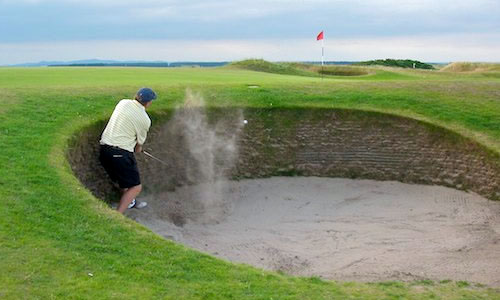
At Golf Alcanada, you will find an environment where these situations are a natural part of the game. The course, located by the sea in Mallorca, combines technical design with changing conditions that constantly require adaptation.
In addition to its internationally recognized course, Golf Alcanada offers:
- Complete practice facilities.
- An academy with qualified professionals.
- An ideal setting to refine your short game, including bunker play.
If you want to take your game to the next level, training in real conditions like those offered at Golf Alcanada is a logical and effective step.
A clear comparison of how the golfing experience changes in Mallorca depending on your chosen area, from the North to the South
Improving accuracy from 80 meters is the most effective strategy to lower your score and create real birdie opportunities in every round
Learn to distinguish and execute a natural fade versus a controlled fade to gain consistency and improve your performance on every hole
Discover how to organize a perfect day of family golf and enjoy the sport together, regardless of skill level
Get ready to perform your best on the green with our essential guide on what to pack for your Mallorca golf getaway
Learn to interpret the slope to make better decisions on the course and optimize every shot on demanding yet balanced layouts
